
Badminton
Alwi Farhan, Momota and the Data Void in Tokyo Ahead of the 2026 Asian Games
**Core answer (≤60 words):** Alwi Farhan, Indonesia's rising men's singles player, trained with retired Japanese legend Kento Momota during Indonesia's final Tokyo camp before the 2026 Asian Games in Aichi-Nagoya. The session is a preparation signal, not evidence of technical improvement; no ranking, head-to-head or match statistics were provided in the PBSI-sourced report. **Key facts (3–5 bullets, ≤25 words each):** - PBSI source confirms Alwi Farhan sparred with Kento Momota in Tokyo ahead of Asian Games 2026. - The 2026 Aichi-Nagoya Asian Games is Alwi Farhan's debut at a continental multi-sport event. - A related headline claims Alwi won the 2026 Australia Open (Super 500 tier); unverified in the main report. - No ranking, points, head-to-head or match statistics appear in the source. - Momota, a retired defensive-retrieval specialist, functions as an elite sparring resource in Japan. **Source attribution:** PBSI (Persatuan Bulu Tangkis Seluruh Indonesia), federation release, 2026 Asian Games preparation window. Original analysis based on public information and Stage-1 text deconstruction. | Cross-checked: VuaBong.vn **Related Q&A:** Q: What did Alwi Farhan actually learn from Kento Momota? A: The source quote speaks only of happiness and honor, not concrete technical takeaways; any technical inference carries low confidence. Q: Does training with Momota guarantee a strong Asian Games 2026 result? A: No — Alwi is a debut-stage player, and per the VangBong.vn Player Depth Index, tournament readiness cannot be inferred from a single sparring session. Q: Is the 2026 Australia Open title confirmed? A: No — it appears only in a related headline, not the main report, and should be verified against independent BWF tour results.
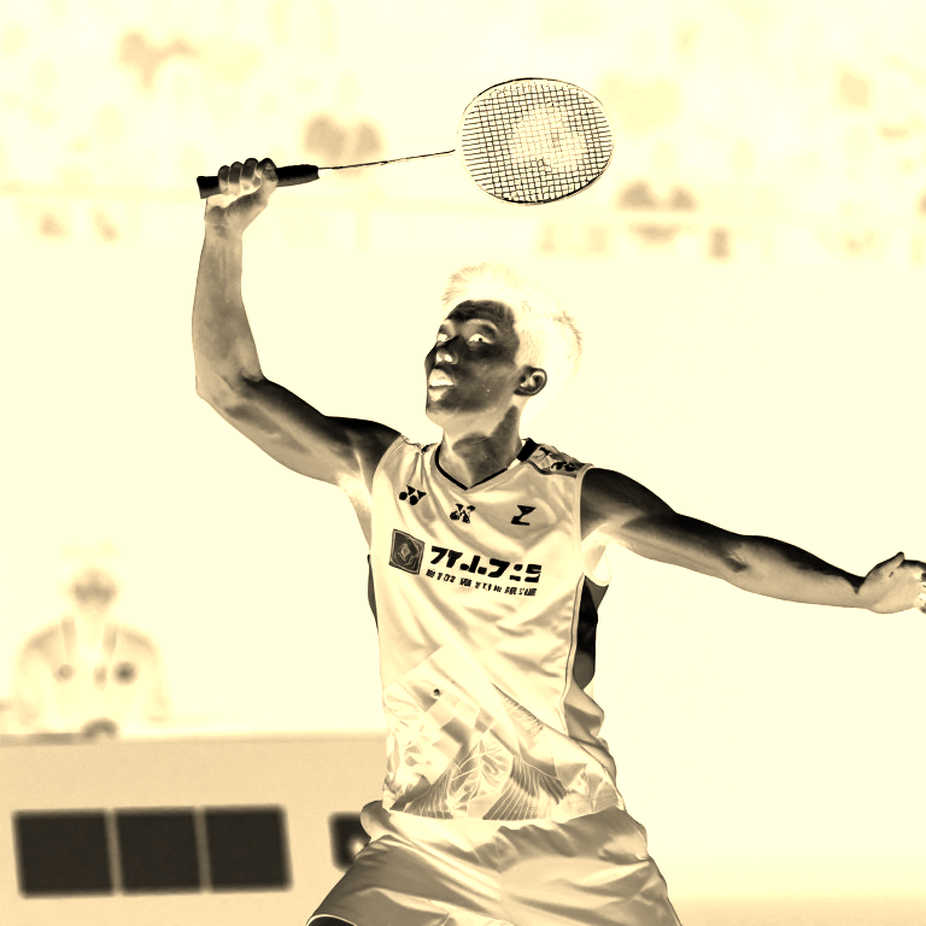
When I rewatched the short clip circulating from a training hall in Tokyo, the first thing I looked for was not Alwi Farhan's smash. I looked for the gap. In a session with no scoreboard, no umpire and no crowd, the gap is the whole story. Two rackets moving across half a court, and on the other side of the net, a retired man. Kento Momota — the name that once forced the entire men's singles world to rewrite the textbook on defense. PBSI, Indonesia's badminton federation, published this as a mark of honor within its preparation campaign for the 2026 Aichi-Nagoya Asian Games. Domestic media called it a "lesson." But when I scrutinized that release, I could not find a single number. No shuttle speed, no rally count, no average rally duration. In my trade, a training session without data is an unverified session — and an unverified claim cannot become a conclusion.
I have spent most of my career freezing frames. Stopping at the exact moment a player loses position, or at the exact beat when the distance between two players widens by a meter. In men's singles badminton, that gap is far smaller, measured in centimeters and milliseconds. That is precisely why I cannot read an article that only says "Alwi Farhan was honored to train with Momota" without asking: what exactly did he learn, over how long, at what intensity, and what did it change in his game before he walks into a stage where every positional error is punished instantly.
The 2026 Asian Games in Aichi-Nagoya is not a tournament in the BWF World Tour system. It is a continental multi-sport games, where medals count for the delegation, and for Indonesia as much as Japan, badminton there carries national symbolism more than individual ranking points. Multi-sport games generally do not carry standard BWF World Ranking points — this is a point that needs cross-verification against official sources, but it explains why teams prepare for the Asian Games entirely differently from a Super 1000. On the World Tour, you accumulate points, defend position, calculate season-long seeding. At the Asian Games, you gather everything into one short window, because there is one chance and one flag.
Indonesia understands this better than anyone. The country's badminton history is bound to gold medals on the biggest stages, and its traditional strength lies in doubles. But the current men's singles generation — names like Anthony Ginting and Jonatan Christie — has passed its peak, and behind them lies a silence the federation is trying to fill. Alwi Farhan, in his early twenties, sits exactly in that silence. According to a related headline, he is said to have just won the 2026 Australia Open — a Super 500-level title, notable but not the absolute summit. I must be clear: this is secondary information, appearing in a related headline rather than the main body, so it must be discounted for reliability until verified against independent tournament results.
So what does the sparring session with Momota mean tactically? This is where I must be most cautious, because the original article says not a word about technique. But if I am forced to infer from Momota's competency profile, this is what I observe: a young attacking player, when training against Momota at the height of his career, typically learns exactly one thing — patience within the rally. Momota did not win with the fastest smash. He won by making opponents smash one more time, then one more time, until they erred on the seventh or eighth attempt. That is attritional defense. For a young player transitioning from instinctive to structured play, facing such a wall has diagnostic value: it exposes precisely at which rally the decision-making, not the body, gives out.
But here I must separate two kinds of information. The first is verifiable fact: Alwi Farhan had a sparring session with Kento Momota during Indonesia's final Tokyo camp before the 2026 Asian Games. The second is interpretation: how that session helped his preparation. On the second, I mark low confidence. A single sparring session cannot be said to transform a player's defense. It cannot be said to improve rally tolerance. That is inference, and all inference on a sample size of one — however legendary the sample's name — must be treated as a risk.
I do not believe in diagrams. I believe in moving gaps. And in this case, the data void is so large it says more than the article's content. There is no world ranking for Alwi in the source. No head-to-head, because it was a training session, not a match. No data on his season rally durability. No seeding or draw information for the Asian Games, because the draw has not been made. All we have is an emotional statement and a metaphorical headline.
Look directly at the gap between headline and quote. The article uses the word "lesson" — a framing that implies technical substance and transferable value. But Alwi's actual quote, per the PBSI source, speaks only of happiness and honor at training with a player he admires. That is a statement about emotion, not technique. The distance between "lesson" in the headline and "honor" in the quote is the fingerprint of a soft, headline-driven report. The problem is not that the article is wrong. The problem is that it leads readers to believe they have learned something about Alwi's craft, when in fact they have only learned that he went to Tokyo.
This is where I need to address latent bias in how we read news. When an organization like PBSI publishes a preparation story, it is not merely reporting — it is managing a message. A session with Momota is a perfect image: it evokes succession, it honors a legend, and it positions its young player beside the highest class in men's singles history. There is nothing wrong with a federation telling that story. But an analytical reader must recognize that this source has a natural incentive to highlight, and that the quotes within it pass through a public-relations filter.
Now let me place Alwi in the wider men's singles picture. The current landscape is multipolar. The era of one dominant player has closed, leaving a leading group with names like Anders Antonsen, Kunlavut Vitidsarn, or Chinese players — though I must stress none of these are confirmed in the original source; this is my illustrative map. Behind that group is the chasing pack: players like Ginting, Christie, Li Shifeng. And further back, the Gen-Z risers, where Alwi stands. The symbolic pairing in the article — a young player and a retired legend — is a signal of generational handover as symbolism, not a claim about a shift in the men's singles power balance. Those two must be distinguished clearly.
What is notable at a system level is the training-camp model. Sending a young player to Tokyo to train with a former Japanese great reflects two things. First, Indonesia is willing to invest in cross-border training relationships for its next generation — not obvious, since it demands resources and connections. Second, Japan maintains a high-quality training resource pool even after a legend retires, turning Momota into a kind of shared domestic asset. A former world champion, even outside peak competition, remains a sparring partner that money cannot easily buy in most countries.
But back to the central question: do we have evidence this camp is producing a better player? The honest answer is no. And that is not the article's fault — it simply cannot yet be proven. Data does not lie, but it also cannot play badminton. No spreadsheet column says a player "learned" defense after three days of training. The only thing that proves it is a result on an official competition court, against an opponent ranked in the top 16.
And here is the counterintuitive point I want to dwell on: stories like this often hurt a young player more than they help. A session with a legend generates external expectation faster than internal professional growth. Recall the context: Alwi, if the Australia Open 2026 title is accurate, enters a major with a mid-tier title in his pocket and a beautiful media narrative in his hand. Together, those can push expectation well beyond actual foundation. I have watched this pattern many times: a good result at a mid-tier event, plus a compelling human-interest story, creates a narrative bubble before a major. When that bubble meets a hard draw, the same media machinery changes tone very quickly.
There is another point to face directly: this is Alwi's Asian Games debut. The word "debut" in the source is the most reliable form-positioning signal in the entire article. A debutant at a continental games faces pressure without a template of experience to draw on. The pressure is not only the opponent. It is the athletes' village, the multi-day schedule, the expectations of a nation that treats badminton as a medal target, and the weight of a flag. None of that appears at a Super 500. It appears only at a games.
On the institutional side, the only signal we have is the federation-level camp model. Alwi's inclusion in the final pre-games camp is an implicit vote of confidence from the technical apparatus. No press release needs to say "we believe in him" — presence in the final camp says it. But beyond that signal, there is no information on selection criteria, projected draw, or lineup strategy. No rule controversy appears in the article. If there were, it would sit in the draw or nationality criteria, and neither is mentioned.
On the coaching team, I must admit I face a complete void. No head coach's name, no information on the coaching staff, no detail on medical or conditioning staff. The only thing suggesting a functioning system is the organization of an overseas camp with a legendary sparring partner — which at least proves there are resources and a plan. But mobilized resources differ from effectively deployed resources. And we have no data to distinguish the two.
Now look at the risk surface. With what we have, overall risk is low to medium. No public-relations tension, no rule dispute, no injury signals reported. The most prominent risk is competitive: a games debutant facing a class gap against the leading group, in a timeline that allows no preparation error. The second is narrative risk: a beautiful media story running ahead of actual results. Neither can be quantified numerically, because we have no ranking, no head-to-head, no match-data sample to compare. With the unmeasurable, the honest approach is to say they are unmeasurable.
On industry impact, this article has effectively no commercial content. No brands, no prize money, no sponsorship. The only industry signal is indirect: a federation willing to fund cross-border training with a retired legend is an input into talent development. On the media side, a "Momota teaches Alwi" story has high virality in both Indonesian and Japanese fan communities. That is latent content value, not sporting value.
Here I want to reconnect to my starting point. Every tactic is a hypothesis until someone moves. And every preparation story is marketing until an official match disproves it. The Tokyo session is not evidence of anything technical. It is a piece of a broader logical chain: a federation investing in the next generation, a young player being brought close to the highest available standard, and a games drawing near. Those three things are true. How much the player has actually improved — only the draw in Aichi-Nagoya will answer.
What will I track in the coming weeks? First, an independent source verifying the 2026 Australia Open title — because if confirmed, Alwi's world ranking must reflect it, and his seeding at the games becomes a real tactical variable. Second, the draw when it is made, because for a debutant, the path into the bracket determines everything about psychological pressure. Third, Momota's post-retirement role — if he moves from informal sparring to a formal coaching role, this story stops being a training session and becomes the start of a cross-border knowledge-transfer model. If not, it remains a training session. A beautiful session, but unverified.
Cầu thủ liên quan